
Ea2Sa—Enterprise Architecture to Solution Architecture—is the architectural foundation behind the Ea2Sa Automation Agency. It is not a standalone framework, a single technology, or a collection of disconnected diagrams. It is a structured approach for translating enterprise intent into governed AI automation, operational capabilities, and measurable business outcomes.
Ea2Sa addresses one of the most important questions facing organizations adopting artificial intelligence:
How do we ensure that AI investments, automation initiatives, and agentic solutions deliver the outcomes the enterprise actually needs?
Rather than beginning with a model, platform, or automation tool, Ea2Sa begins with business value. It connects strategy, capabilities, processes, data, technology, governance, and delivery so that AI becomes part of the enterprise operating model—not another isolated experiment.
The Ea2Sa Enterprise-to-Solution Architecture Model
The Ea2Sa model provides a high-level view of how business strategy becomes executable AI-enabled change, and how that change produces measurable operational and financial results.
It creates traceability across the complete transformation lifecycle:
Enterprise value drives capabilities. Capabilities define required services. Services identify automation opportunities. Automation opportunities become governed solutions. Solutions are delivered through measurable work packages and continuously improved through operational feedback.
This chain of alignment prevents organizations from investing in AI without a clear understanding of the business problem, the required capability, the governance boundaries, or the expected return.
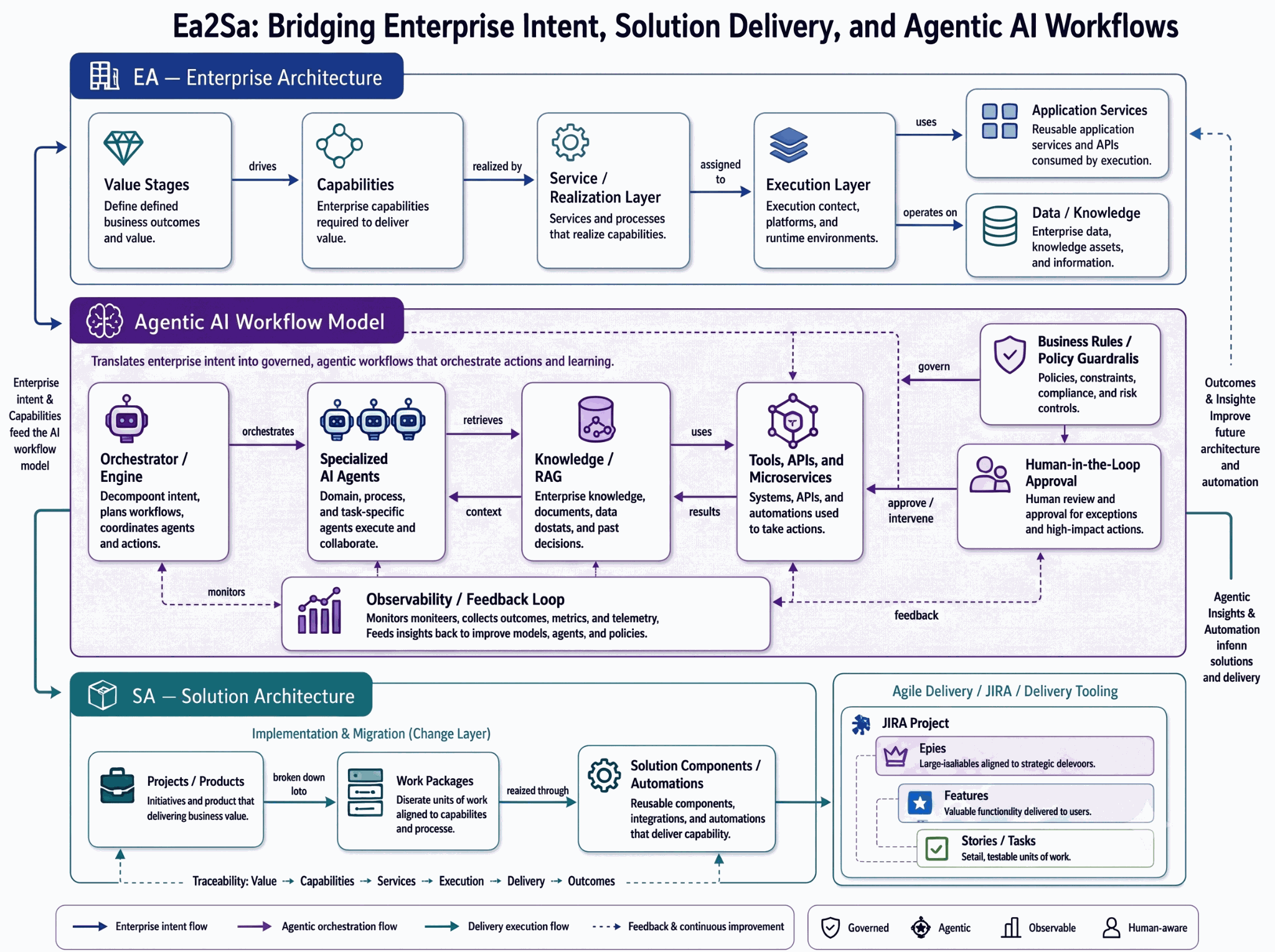
Two Connected Perspectives: Enterprise Architecture and Solution Architecture
Ea2Sa deliberately distinguishes between Enterprise Architecture and Solution Architecture while maintaining a strong connection between them.
Enterprise Architecture defines why the organization should invest, what outcomes it is pursuing, and what capabilities it must develop or improve.
Solution Architecture defines how those capabilities will be implemented through AI, automation, data, applications, integrations, infrastructure, and operating processes.
This separation helps prevent a common failure pattern in AI transformation: leadership defines an ambitious AI strategy while delivery teams implement disconnected tools, copilots, agents, and proofs of concept without sufficient architectural context.
Ea2Sa ensures that strategic intent remains connected to implementation decisions.
Enterprise Architecture: From Business Value to AI-Enabled Capability
The Enterprise Architecture perspective begins with Value Stages. These represent outcomes that matter to business owners, executives, customers, and stakeholders.
Examples may include:
- Reducing administrative workload
- Improving customer response times
- Increasing revenue conversion
- Reducing operational risk
- Improving decision quality
- Recovering employee capacity
- Strengthening compliance and governance
These outcomes are not technologies or projects. They are the measurable reasons the organization is investing in automation and artificial intelligence.
Capabilities sit at the center of the model. A capability describes what the enterprise must be able to do, independent of a specific organizational structure, vendor, application, or AI model.
Examples include:
- Qualify incoming opportunities
- Generate proposals
- Process financial transactions
- Analyze operational performance
- Manage organizational knowledge
- Coordinate customer communications
- Detect exceptions and operational risk
Capabilities provide stable planning anchors that remain relevant even as technologies, organizational structures, and AI models change.
Capabilities are realized through business and application services. These services are connected to processes, data, systems, integrations, policies, and execution environments. This ensures that AI automation remains grounded in operational reality rather than being treated as a detached technical capability.
AI Automation as an Enterprise Service
Within Ea2Sa, AI is not positioned as a replacement for architecture, governance, or human accountability. It is treated as an enabling service within a broader enterprise system.
An AI-enabled service may include:
- Large language models
- AI agents
- Agentic workflows
- Deterministic automation
- Retrieval-augmented generation
- Business rules
- Human-in-the-loop approvals
- APIs and microservices
- Enterprise data sources
- Observability and audit controls
The specific technology is selected only after the business capability, workflow, risk profile, and expected outcome are understood.
This prevents organizations from forcing every problem into a generative AI solution when conventional automation, integration, analytics, or process redesign may be more appropriate.
Solution Architecture: Turning Intent into Governed AI Change
While Enterprise Architecture defines intent, Solution Architecture governs implementation.
This work occurs within the Implementation and Migration Change Layer, where AI and automation initiatives are organized into solution increments, projects, products, and work packages.
Work packages are the smallest architecturally meaningful units of change. Each work package represents a concrete commitment to improve or realize an enterprise capability.
Examples may include:
- Automating lead intake and qualification
- Introducing an AI-assisted proposal workflow
- Connecting financial transactions to a governed classification process
- Implementing a knowledge retrieval agent
- Creating an exception-management workflow
- Establishing AI observability and audit logging
- Introducing human approval for high-risk decisions
Nothing should enter delivery without traceability to a defined capability, service, business outcome, and governance requirement.
This traceability allows Ea2Sa to answer not only what is being built, but also:
- Why it is being built
- Which capability it supports
- Which business outcome it is expected to improve
- Which data it requires
- Which risks and policies apply
- Who remains accountable
- How success will be measured
Connecting Architecture to AI and Agile Delivery
Ea2Sa integrates with modern delivery and automation platforms rather than competing with them.
Solution Architecture work packages may be implemented through delivery artifacts such as:
- Portfolio initiatives
- Product roadmaps
- JIRA projects
- Epics and user stories
- n8n workflows
- AI agents
- Microservices
- APIs
- Cloud services
- Data pipelines
- Infrastructure-as-code deployments
This creates a clean and auditable chain of alignment:
Business value drives capabilities. Capabilities drive services. Services identify automation opportunities. Opportunities become solution work packages. Work packages are delivered through agile and automated execution. Outcomes are measured and fed back into the architecture.
Architecture therefore becomes an active control mechanism for delivery—not a static document created before implementation begins.
Governance, Policy, and Human Accountability
AI automation introduces new concerns that traditional application delivery does not fully address. These include model behavior, prompt management, data exposure, decision accountability, hallucination risk, bias, explainability, and uncontrolled agent actions.
Ea2Sa incorporates governance directly into the solution architecture.
Governance may include:
- Role-based access controls
- Data classification and privacy boundaries
- Human-in-the-loop decision points
- Model and vendor selection criteria
- Prompt and workflow versioning
- Policy-as-code enforcement
- Decision and execution logging
- Output validation
- Confidence thresholds
- Exception handling
- Agent permissions and action boundaries
The objective is not to slow AI adoption. It is to make AI automation safe, repeatable, auditable, and operationally sustainable.
Measuring Return on Automation with AI
Ea2Sa connects architectural decisions to measurable outcomes through ROAi™—Return on Automation with AI.
ROAi™ evaluates more than token consumption, model cost, or workflow execution volume. It examines whether an AI-enabled solution creates meaningful operational and business value.
Measures may include:
- Hours of work recovered
- Reduction in process cycle time
- Improved response speed
- Increased throughput
- Reduced error rates
- Increased conversion
- Lower operational cost
- Reduced compliance exposure
- Improved customer experience
- Increased organizational knowledge reuse
This allows organizations to determine whether an automation is merely functioning or actually creating value.
Continuous Learning and Operational Improvement
AI automation should not be treated as a one-time implementation. Each workflow, agent interaction, exception, correction, and human decision can become a source of organizational learning.
Ea2Sa establishes the architectural foundation for capturing this feedback and using it to improve:
- Business rules
- Prompts
- Knowledge sources
- Agent instructions
- Decision thresholds
- Workflow routing
- Data quality
- Governance policies
- Operational performance
This creates a continuously improving system in which automation becomes more effective while remaining within defined enterprise controls.
Why Ea2Sa Matters
Ea2Sa makes enterprise architecture usable in the age of artificial intelligence.
It enables organizations to adopt AI without losing strategic alignment, governance, operational control, or accountability. It provides a shared language for executives, business owners, architects, technologists, automation specialists, and delivery teams.
For smaller organizations, Ea2Sa provides the architectural discipline of a larger enterprise without unnecessary complexity. For larger organizations, it provides a way to connect AI strategy to portfolios, platforms, products, and delivery execution.
Ea2Sa helps organizations move beyond disconnected AI pilots and isolated automations toward governed, capability-driven, and measurable transformation.
Architecture should not slow AI delivery.
It should ensure that AI delivery is purposeful, governed, reusable, and capable of producing measurable enterprise value.